
I have spent a significant part of my career working with innovators, particularly those in the scaling stage. These are companies that have often moved past the initial excitement of a seed round and are now navigating the complex journey of global expansion. They are often between ten and two hundred employees; a stage I call the sweet spot of scaling. In this phase, the science is usually validated, the funding is often secure, and the technical team is brilliant. Yet, there is a recurring pattern that I see leading to unnecessary struggle and, in many cases, total failure.
When we look at the data for startup survival, the results are quite painful. Nine out of ten startups eventually fail. When researchers investigate why this happens, the most common reason, accounting for 42% of those failures, is simply that there was no market need. It is not that the product was poorly built or that the founders were not working hard enough. Usually, they do everything “by the book”. The issue is that they go looking for problems where there were none. They entered a loop where they were conditioned to invent a pain point just to justify a solution they had already decided to build.
This is the narrative gap. It is the distance between a brilliant technical tool and a human community that wants to use it. If you want to build a brand that lasts, you have to move from what I call the broadcast theater to a real conversation.
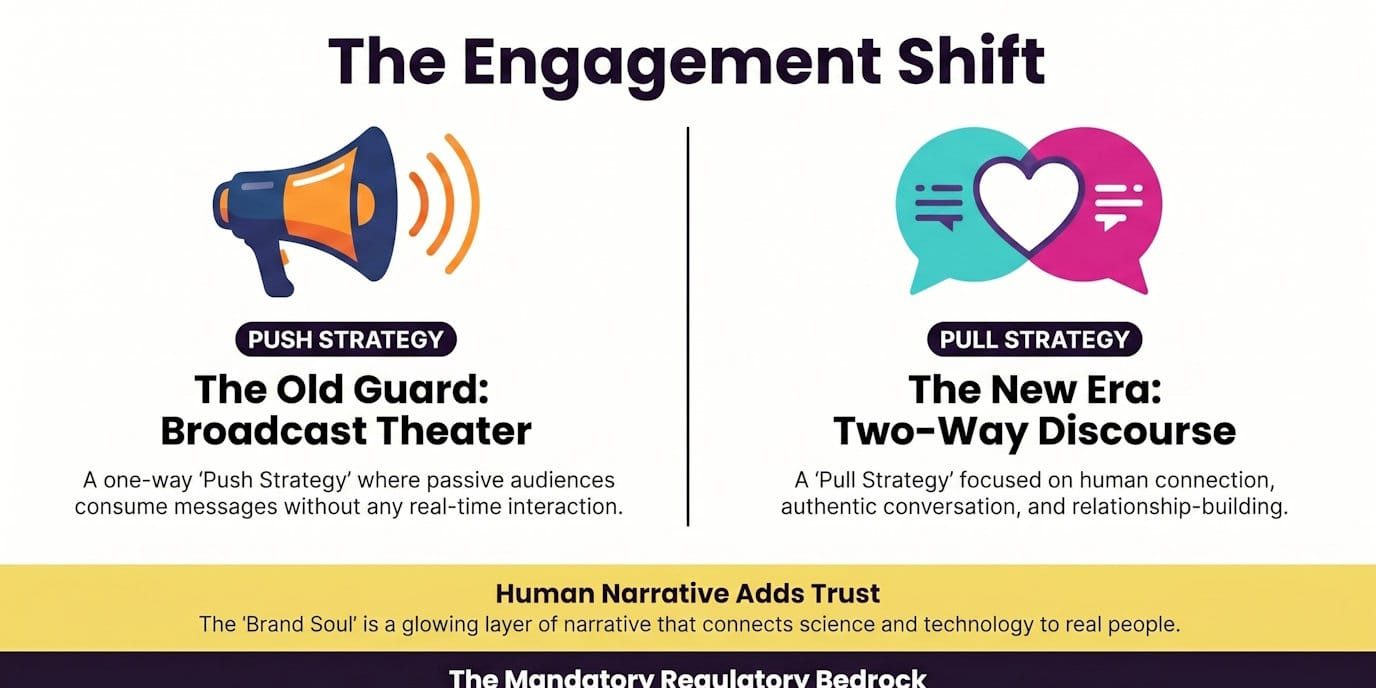
The Broadcast Theater of Technical Data
Think about the last time you were in a theater. You sat in a dark room and watched a play on a stage. The actors talked at you, but you did not engage with them. This is how many scaling firms, especially in highly regulated sectors like biotech or fintech, approach their marketing. They stand on a digital stage and broadcast numbers, data, clinical milestones, and technical specifications. They hope someone is listening, but they do not actually start a discourse.
This approach is essentially a push strategy. You are pushing your product or service and your facts at people. But people do not want to be talked at. They want to be part of a conversation. They want to feel that the brand they are interacting with has a soul. When a company only focuses on its data, it remains narratively silent. It becomes a tool, and tools are easily replaced. Communities, however, are not. And yes, before you ask, this universal truth applies to B2B as well as to B2C companies.
Scaling firms often believe that good data speaks for itself. It does not. Data is just noise unless there is a human community ready to listen and trust you. This is why we need to transition from narrow labels like B2B or B2C to a much broader philosophy: B2P, or Business to People.
Putting the People Back at the Center
Every form of marketing is ultimately oriented toward people. Whether your target is a corporate decision maker at a large pharmaceutical firm or a bank, or a patient waiting for a new therapy, you are talking to a human being. That person has moods, fears, physical afflictions and emotional, and families. They have a personal stake in whether your innovation works or not, even If this is not immediately clear to you, or to them.
In my work, I help founders fix the order of their messaging using a model focused on three questions: Why, Who, and What – in that order. Most founders start with the “what”. They can explain every detail of their technology or their science, but they struggle to explain who it is for or why it matters to a human life.
When you start with the why, you understand the core need. When you define the who, you understand the communities you can create and address, and their shared experiences. Only after those two are clear do you articulate the “what”. When you define your product or service based on the people it serves, you end up with a unified message that resonates with every stakeholder in your ecosystem. This consistency builds massive trust. This trust drives growth and revenue.
The biotech case: The Linguistic Ghost of Clinical Trials
Nowhere is this narrative gap more visible than in the biotechnology sector. I recently reviewed the digital presence of several clinical stage firms and noticed a recurring word: subjects.
In a clinical setting, calling a participant a “subject” is technically accurate. It is regulated and precise. But when that technical language moves into the public eye, it creates a distance that is hard to bridge. When we refer to the human beings in a trial as subjects, we are looking at them through a microscope or as rats through the bars of a cage. We are treating them like variables in an equation or data points on a spreadsheet.
If you want to build a movement, you have to choose different words. By choosing to say patients or partners instead of subjects, you acknowledge the human life at the other end of your innovation. You shift the focus from merely treating a disease to protecting a human being. This is not just a marketing trick; it is a fundamental shift in how you view your work. Investors buy into movements, not just data. They want to see that a company understands its ecosystem and that the brand has a soul.
Narrative Infrastructure for Lean Teams
One of the biggest challenges for a firm with under twenty people is what I call narrative fatigue. At this stage, every hire is a risk. Many clinical biotechs do not have a dedicated marketing lead, which means the responsibility for storytelling falls entirely on the technical or scientific founders. They end up trying to be their own agency, which is a recipe for exhaustion and inconsistent messaging.
You do not need a massive marketing department to do this right. You just need to be intentional. You need narrative infrastructure. One easy fix for this fatigue is to build what I call a Marketing Master File. This is a central repository that houses your keywords, your unique voice, your values, and your understanding of your communities and a whole lot more.
When your team has a clear roadmap for your brand story, they no longer have to guess what to say. They can stop broadcasting and start engaging. They can move away from the theater and toward a community discourse where the audience is not just watching, but actively participating.
Precision Should Not Cost Compassion
We live in a world where technical specs are just the starting point. The real value is in the connective tissue you build between your science and the people it serves. Precision in the lab is a fundamental requirement, but precision in your terminology should not come at the cost of your compassion.
When your community feels like they are partners in your mission, your brand stops being a data point and starts being a living organism. High quality engagement is not about a body count of followers or the total number of likes on a profile. It is about immersion. It is about how many people are actually connected to your vision.
It is time for the industry to stop just reporting milestones and start engaging in discourse. I advocate for putting people back at the center of science. If you can share your opinions consistently, spread your name as widely as possible, and show evidence of success within your niche, you will begin to attract an audience that is inspired by what you have to say.
Sustainable growth is not bought through ad campaigns or post & forget on social media; it is driven by reciprocity. The more value you create and give away to your community, the more you will be trusted. And trust is the only currency that truly scales.