

A B2P Executive Case Study on Starbucks' Journey from Digital Transaction Theater to Community-Driven Growth
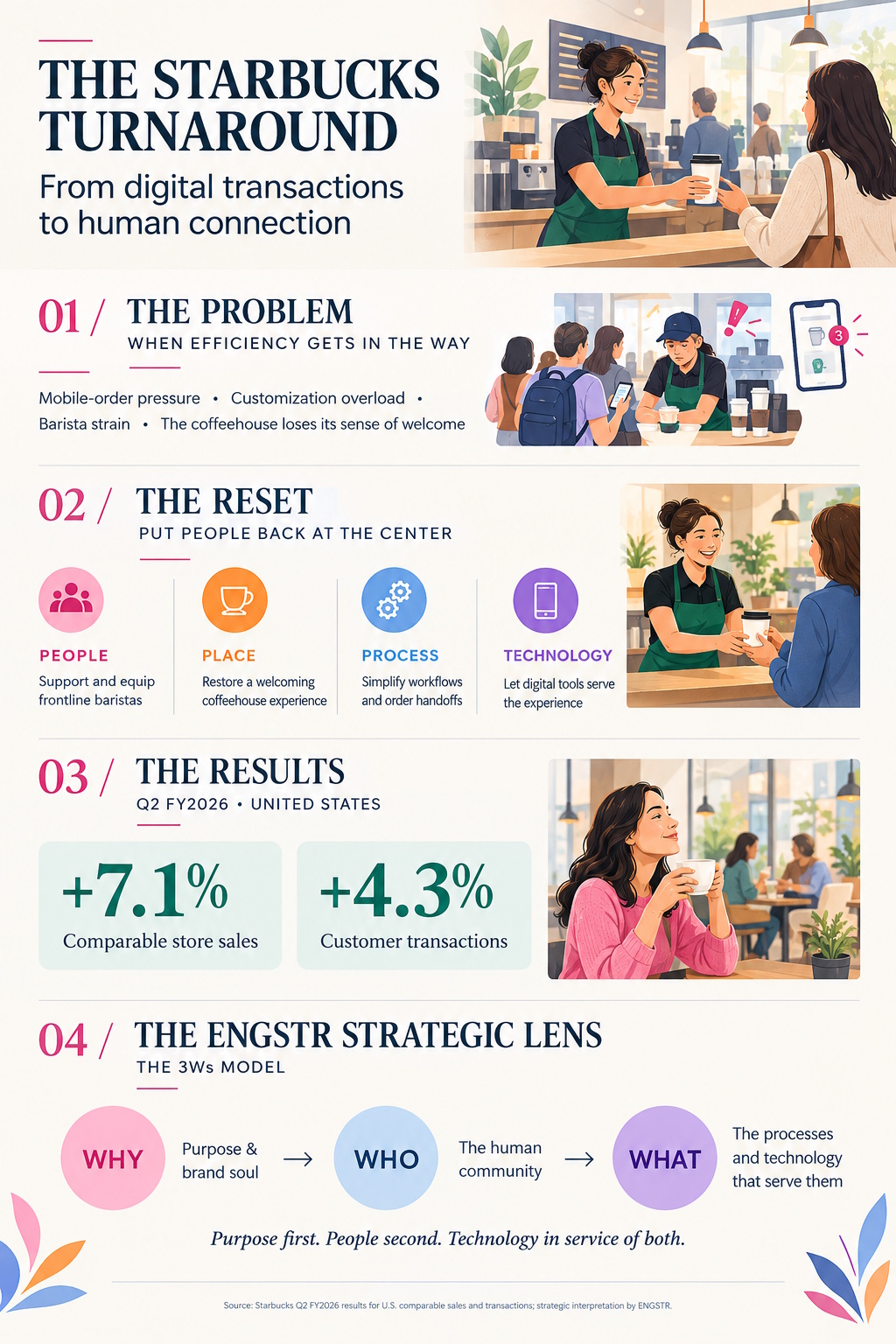
The Starbucks turnaround represents a definitive real-world proof point for Business to People (B2P) strategy over pure digital transaction theater. Between 2022 and 2024, Starbucks over-indexed on mobile app order volume, aggressive customization, and automated throughput, resulting in a $220B valuation drop and 7 consecutive quarters of declining foot traffic. Under CEO Brian Niccol’s ‘Back to Starbucks’ restructuring, the company shuttered 500 underperforming locations, eliminated corporate friction, re-funded frontline barista hours, and restored the physical ‘third place’ coffeehouse experience. By Q2 2026, North American same-store sales surged 7.1% driven by a 4.3% increase in actual customer foot traffic and 430 basis points of operating margin expansion, proving that long-term enterprise value is built on human community trust rather than transaction algorithms.
Part I: Factual & Operational Analysis of the $220B Transformation (2022 to 2026)
Why Did Seven Consecutive Quarters of Customer Traffic Collapse Occur?
Between 2022 and late 2024, Starbucks experienced one of the most severe operational and valuation contractions in modern corporate history. After reaching an all-time peak market capitalization of roughly $280B in late 2021, the company’s valuation tumbled by nearly 80% to approximately $57B by September 2024, erasing over $220B in shareholder value.
This financial collapse was not caused by external macroeconomic headwinds alone, but by an internal operational shift: the relentless pursuit of digital transaction volume at the expense of store-level human experience. Under the ‘Consumer Direct Acceleration’ model, corporate leadership focused heavily on pushing mobile app adoption, digital rewards, and complex drink customizations.
The resulting operational friction manifested across three critical areas:
- App Order Surges & Bottlenecks: Mobile ordering grew to represent over 30% of total transactions. However, stores lacked the physical infrastructure and staffing models to handle simultaneous rushes of mobile orders, drive-thru traffic, and in-store walk-ins. Handoff counters became chaotic fulfillment centers.
- Customization Overload & Barista Burnout: Promoting endless drink modifications created extreme operational complexity. Baristas spent up to 30% of their working hours managing complex multi-step drink recipes and app notifications, leading to record employee turnover and widespread labor friction.
- Destruction of the ‘Third Place’ Environment: To maximize speed, stores removed seating, dimmed lighting, and eliminated warm store amenities. Cafes began feeling like sterile, noisy pickup stations. Customers seeking a welcoming coffeehouse experience stopped visiting, leading to 7 consecutive quarters of negative or stagnant foot traffic.
How Did Activist Investors Catalyze the Executive Leadership Reset?
By mid-2024, the prolonged traffic decline attracted major activist hedge funds, including Elliott Investment Management and Starboard Value, which quietly built multi-billion-dollar positions in Starbucks stock. Public SEC filings and investor communications revealed intense pressure on the board of directors regarding operational missteps, declining store margins, and brand erosion.
In August 2024, the Starbucks board executed a swift executive reset, firing former CEO Laxman Narasimhan and appointing former Chipotle CEO Brian Niccol as Chairman and Chief Executive Officer. Niccol immediately established a bold turnaround directive titled ‘Back to Starbucks’, making a public commitment to return the global chain to its core identity as a warm, human-centered coffeehouse.
What Were the Core Deliverables of the $1B Restructuring Plan?
Executing the turnaround required aggressive operational restructuring to align corporate overhead with store-level reality. In late 2024 and early 2025, Starbucks initiated a $1B operational wipeout designed to eliminate structural bloat and re-fund frontline execution:
- Store Portfolio Optimization: Starbucks abruptly shuttered over 500 underperforming North American locations that could not deliver the warm coffeehouse environment or sustain healthy store-level margins, resizing the North American footprint to roughly 18,300 high-performing units.
- Corporate Headcount Reduction: Corporate support overhead was streamlined by cutting 900 non-retail corporate roles. Crucially, corporate leadership protected all store-level barista hours and redirected administrative savings directly into store staffing.
- Green Apron Service Standards & Labor Reallocation: Store operating models were re-engineered to ensure baristas had dedicated roles for morning and afternoon dayparts. Complex menu items were simplified, and baristas were given dedicated support roles to handle mobile order handoffs without interrupting guest connection.
- Dynamic App Throttling Technology: To prevent counter congestion during peak morning rushes, Starbucks implemented dynamic app throttling technology, giving local store managers the authority to pause mobile ordering when in-store customer volume peaked.
- The 1,000-Store Renovation Wave: Starbucks launched a massive physical makeover across thousands of stores, installing cozy seating, power outlets, warm lighting, and dedicated ceramic mug service for customers staying in-store.
What Do the Verified 2026 Financial Results Prove?
The operational data from 2026 confirms that returning to human-centered execution delivers immediate financial recovery. In its Q2 and Q3 FY2026 financial disclosures, Starbucks reported results that surpassed analyst expectations across every key operating metric:
- North American Sales Surge: Same-store sales in North America rose 7.1% year-over-year in Q2 2026, accelerating to 8% in Q3 2026, marking four consecutive quarters of positive top-line growth.
- Rebound in Customer Foot Traffic: Unlike competitors relying solely on price hikes to inflate revenue, Starbucks’ sales growth was driven by a 4.3% increase in actual customer transactions, representing the strongest foot traffic momentum in over 3 years.
- Operating Margin Expansion: GAAP operating margins expanded by 180 basis points in Q2 and 430 basis points in Q3 to reach 14%, proving that investing in frontline human experience yields significant operating leverage.
Part II: The B2P Strategic Breakdown & Humanized Business Architecture
Why Does Digital Efficiency Without Brand Soul Cause a False Start?
The Starbucks case study is a masterclass in what we call a false start in growth architecture. A false start occurs when an executive team rushes to scale an operational or digital model before validating how that model impacts the human experience (HX) of their real-world stakeholders.
For over a decade, traditional corporate advice pushed businesses to treat digital channels as pure broadcast stages or automated transaction pipes. In retail, this meant turning stores into pickup lockers; in B2B consulting, biotech, and fintech, this meant replacing executive dialogue with automated email sequences, cold ad campaigns, and generic AI text generation.
When a brand replaces authentic human connection with automated transaction theater, three destructive breakdown dynamics occur:
- The Loss of Reciprocity: Engagement is governed by a fundamental rule: give some to get some. When a company treats customers as passive targets to be extracted from rather than human partners to be served, mutual trust vanishes.
- Frontline Alienation: When management optimizes for software metrics without consulting frontline staff (baristas, sales reps, clinicians), those employees become overworked execution bots rather than passionate brand ambassadors.
- The Commodity Trap: Without a distinct brand soul and personal connection, your product becomes interchangeable. Competitors with cheaper pricing or higher ad budgets can instantly siphon away your customers because no emotional bond exists.
How Does the 3Ws Model Re-Order Operational Priorities?
To prevent false starts and restore growth, leadership teams must correct their order of strategic operations using the 3Ws Model (Why, Who, What). Most failing organizations operate in reverse order: they start with ‘What’ (our shiny software tool, our app, our product features), attempt to push it to a vague ‘Who’ (our market persona), and completely forget ‘Why’.
When evaluated through the 3Ws lens, the Starbucks turnaround succeeded because Brian Niccol forced the organization to re-evaluate its priorities in the exact right order:
- Step 1: Re-Anchor the WHY (Purpose & Brand Soul): Starbucks defined its ‘Why’ in 1971 not as ‘selling caffeinated liquid’, but as creating a warm ‘third place’ between home and work where human connection occurs. Niccol stripped away app distractions to honor this original mission.
- Step 2: Map the WHO (The Human Community): Instead of treating customers as generic app users, Starbucks mapped its distinct human communities: frontline baristas (the Green Apron ambassadors), morning commuters seeking reliable speed, and afternoon visitors seeking a comfortable workspace. Supporting baristas became the prerequisite for serving customers.
- Step 3: Re-Architect the WHAT (Operational Mechanics): Only after Why and Who were clear did Starbucks modify its ‘What’: simplifying drink menus, remodelling 1,000+ store layouts, and installing dynamic app throttling. Technology was placed back in its proper role: serving human connection rather than replacing it.
Why Must Executives Measure the HQE Index Instead of Body Counts?
A central reason Starbucks stumbled between 2022 and 2024 was its reliance on vanity body counts: counting active app downloads, total rewards members, and raw order volume. These quantitative metrics showed high transaction numbers, but completely blinded corporate leadership to the fact that customer sentiment, barista morale, and brand trust were decaying.
In B2P management consulting, we advocate replacing hollow body counts with the High Quality Engagement (HQE) Index. The HQE Index is a qualitative metric designed to evaluate the depth, immersion, and sentiment of human interactions rather than superficial clicks.
In a retail environment, an HQE index measures whether a customer stays in-store, interacts warmly with a barista, and feels a sense of belonging. In a B2B, biotech, or fintech environment, a Level 1 HQE interaction is a passive page view or ad click, while a Level 5 HQE interaction is an executive partner referral, an active community contribution, or a multi-year advisory alignment.
How Do Frontline Employees Become Unstoppable Brand Ambassadors?
One of the most profound insights from the Starbucks case study is that internal employee engagement is the primary engine of external brand growth. You cannot build an authentic external brand community if your internal employee community is burned out, ignored, or treated as a cost center.
When Starbucks cut corporate overhead and reallocated resources to support store-level baristas, they activated their strongest marketing asset. A happy, supported barista wearing a Green Apron provides a warm human experience that no $10M ad campaign can ever replicate. Employees who feel seen and supported naturally become brand advocates who defend the company, welcome customers, and drive organic word-of-mouth growth.
Why Is Digital Literacy First a Leadership Paradigm Shift?
Many executive teams confuse digital transformation with buying software. They adopt new app features, implement automated chatbots, or mandate generative AI tools without a high-level strategy. This is not transformation; it is digital clutter.
True digital literacy is a leadership mindset. It means recognizing that technology must serve human strategy, not dictate it. Selecting tools because of a buzzword flood breaks operational workflows. High-level strategic thinking must always come before tactics and execution. When leadership boosts its digital literacy, it gains the discipline to use technology selectively, protecting the Human Experience (HX) where automation fails.
What Are Four Actionable C-Suite Takeaways for Technical Founders?
Whether you are leading a global retail chain, a post-Series A biotech venture, a fintech platform, or a B2B management consultancy, the Starbucks turnaround provides four non-negotiable operational rules:
- Never Trade Community for Ad Algorithms: Performance ad spend and automated apps create short-term transactions, but building an owned trust channel creates long-term brand equity. Protect your human touchpoints at all costs.
- Align Your Strategy in 3Ws Order: Before spending capital on new features or campaigns (What), ensure your leadership team is 100% clear on why your venture exists (Why) and who your core human community is (Who).
- Instrument Your Growth Against HQE: Stop celebrating passive follower counts, impressions, or downloads. Measure active immersion, qualitative sentiment, and customer advocacy.
- Support Your Frontline Community First: Your internal team and frontline staff are your primary brand ambassadors. Equip them with clear roles, proper resources, and executive respect, and they will scale your brand for you.