

A Strategic Growth Architecture Analysis for HealthTech, FemTech, and BioMed Founders
HealthTech and FemTech startups frequently stall during commercialization because founders rely on impact messaging rather than financial proof. Venture investors and institutional healthcare buyers evaluate unit economics, explicit economic buyer pathways, and contribution margins rather than clinical empathy alone. Furthermore, culturally insensitive branding or provocative nomenclature can alienate up to 30% of a regional addressable market. Achieving commercial market access requires replacing mission theater with unit profitability and conducting thorough demographic perception audits across conservative and Orthodox buyer segments before brand launch.
The Empathy Trap in Investor Meetings
In recent discussions across Israeli BioMed, FemTech, and Mental HealthTech founder communities, a candid observation surfaced regarding capital markets: investors do not buy empathy; they buy unit economics. In mission-driven sectors such as women’s health, pediatric care, and mental healthcare, founders frequently fall into what growth architects call the ‘Empathy Trap.’ They structure pitch presentations around emotional patient narratives, societal prevalence statistics, or the moral imperative of solving an overlooked medical problem. While empathy is essential for establishing brand purpose, relying on it as a substitute for financial mechanics creates immediate strategic vulnerability.
When venture capital partners, family offices, or institutional investment committees evaluate a healthcare opportunity, emotional resonance ranks far below operational viability. Impact messaging may secure an initial introductory meeting or a favorable conference feature. However, when the deal team opens the data room, their analysis pivots entirely to financial sustainability, unit contribution margins, and customer acquisition friction. Pitches that emphasize how much a product is needed without detailing who explicitly pays for it are routinely categorized as high-risk science projects rather than scalable commercial businesses.
This strategic disconnect is particularly pronounced in FemTech and digital mental health. Founders often assume that highlighting a massive underserved demographic (for example, 50% of the global population for women’s health) is sufficient to prove market demand. Yet experienced healthcare investors recognize that demographic size does not equal addressable economic demand. If a platform lacks a clear reimbursement code, a validated enterprise buyer, or a sustainable direct-to-consumer margin, market size is irrelevant. Positioning a startup around doing good without proving economic return severely restricts valuation multiples and narrows the interested investor syndicate.
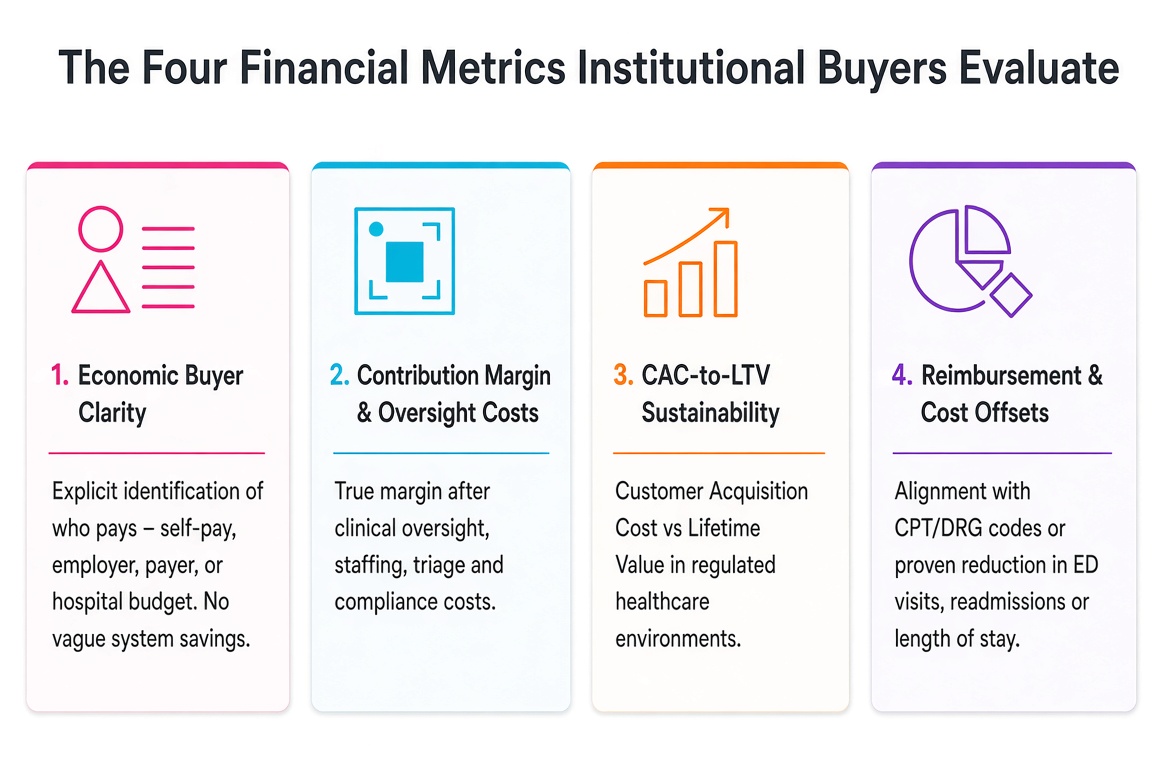
The Four Financial Metrics Institutional Buyers Evaluate
To escape the Empathy Trap, founders must reframe their narrative around the rigorous financial metrics that institutional investors and healthcare procurement committees demand. Under the Business-to-People (B2P) framework, commercial viability requires demonstrating that your technology solves a measurable financial pain point for an explicit decision maker. Healthcare capital markets evaluate four primary financial pillars before committing capital:
- Economic Buyer Clarity: Explicit identification of whether revenue originates from self-pay consumers, self-insured employers, commercial payers, or hospital operational budgets. Broad claims of system savings are rejected without a specific line-item buyer.
- Contribution Margin & Oversight Costs: Gross margins calculated after deducting required clinical oversight, telemedicine staffing, triage support, and regulatory compliance expenses. High gross margins on software vanish quickly if human clinical delivery is underpriced.
- CAC-to-LTV Sustainability: Customer Acquisition Cost relative to Lifetime Value in highly regulated environments. Direct-to-consumer HealthTech platforms often collapse under rising digital ad costs unless backed by organic community referral engines.
- Reimbursement & Cost Offsets: Documented alignment with established CPT or DRG reimbursement codes, or empirical proof that the solution reduces expensive emergency department visits, readmissions, or length of stay within 90 days.
When pitching, scientific founders must lead with these metrics. Rather than stating, ‘Mental health coaching improves patient well-being,’ the commercial thesis must state: ‘Our platform reduces employer disability claims by 18% within six months, generating a 3.2x return on investment for self-insured enterprise health plans at a $6 per employee per month price point.’ This pivot transforms a subjective mission statement into an undeniable commercial thesis.
The Demographic Naming Trap: The Cultural GTM Blind Spot
While unit economics dictate financial viability, brand architecture and nomenclature dictate market access. A compelling debate within a specialized FemTech leadership forum recently highlighted a critical go-to-market blind spot: choosing product names or marketing language that accidentally alienates up to 30% of an addressable regional market before commercial launch.
When technical or consumer-focused founders design brand messaging, they often lean toward explicit clinical terms or provocative, taboo-breaking phrasing. For example, a women’s health startup introduced a clinical questionnaire and product line utilizing direct, anatomically blunt nomenclature. While intended to challenge social stigma and project modern authenticity, the branding created immediate cultural and social friction among conservative, Orthodox, and traditional user cohorts.
In markets characterized by diverse cultural, religious, or traditional demographics, such as Israel, the broader Middle East, Central and Eastern Europe, and significant regions of North America, provocative branding introduces severe distribution friction. Orthodox Jewish, traditional Muslim, and conservative Christian populations represent a substantial portion of healthcare consumers and clinical providers. When product branding triggers social discomfort or perceived modesty violations, several immediate commercial breakdowns occur:
- Clinician Refusal to Recommend: Physicians and nurses hesitate to hand patients marketing materials or recommend digital applications whose titles make patients uncomfortable.
- Institutional Procurement Hesitancy: Hospital ethics boards, regional health funds, and public health systems avoid adopting tools that could draw public controversy or community backlash.
- Patient Drop-Off During Onboarding: Users abandon digital intake questionnaires when language feels intrusive, vulgar, or culturally insensitive, directly degrading user retention metrics.
- Channel Distribution Friction: Retail pharmacies, workplace wellness portals, and app stores in conservative regions restrict promotional features for controversially named products.
Clinical validity is completely meaningless if cultural friction prevents adoption. A product that is 100% scientifically sound but culturally unpalatable effectively surrenders nearly one-third of its potential market share. Building a resilient HealthTech brand requires recognizing that true inclusivity means accommodating traditional and conservative user segments with equal respect.
Applying the 3Ws Model to Brand and GTM Architecture
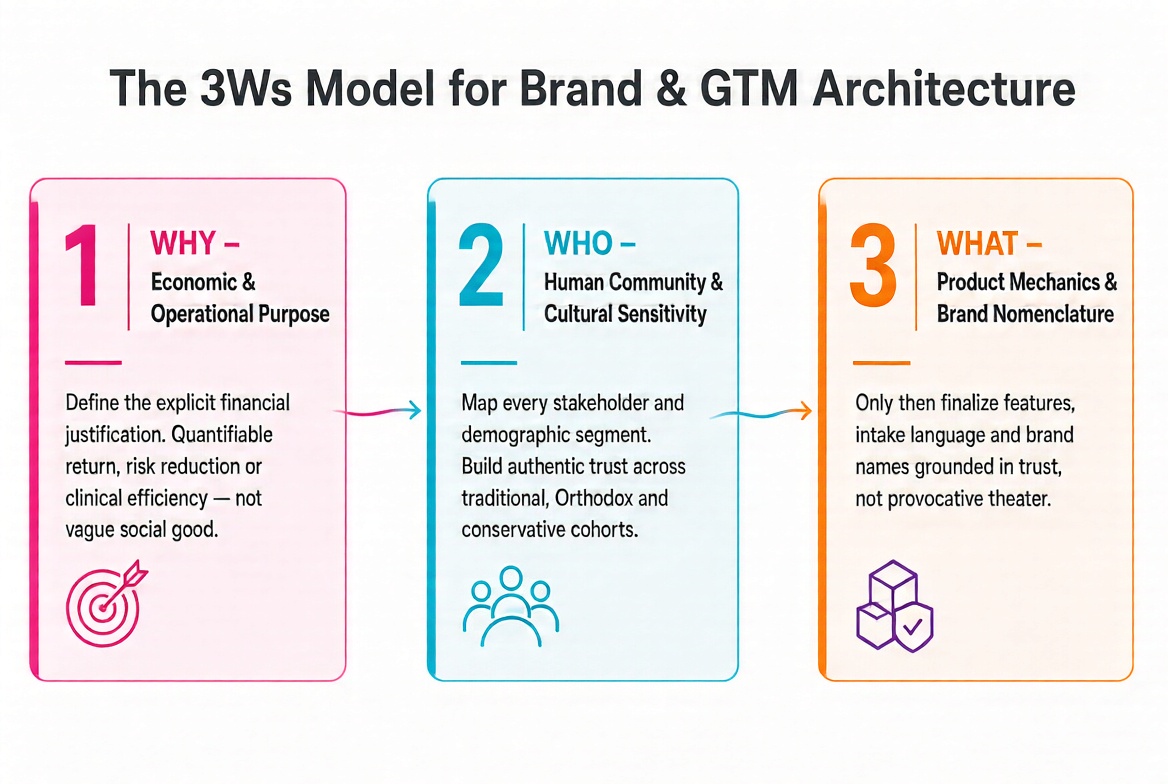
To navigate both investor unit economics and demographic sensitivities, growth architects utilize the 3Ws Model developed by The Engagement Strategy Group. This strategic framework forces founders to align their commercial logic before finalizing brand messaging or product mechanics:
Phase 1: Define the Why (Economic & Operational Purpose)
Establish the explicit financial justification for the product. Why will an enterprise buyer, insurer, or consumer allocate capital to this solution today? The Why must be articulated in terms of quantifiable financial return, risk reduction, or clinical efficiency rather than vague social good.
Phase 2: Map the Who (Human Community & Cultural Sensitivity)
Map the complete human ecosystem, analyzing the cultural norms, communication preferences, and modesty expectations of every user cohort. The Who includes the prescribing physician, the institutional buyer, and the end patient across all demographic backgrounds. Messaging must build authentic trust across every segment rather than alienating conservative groups for cheap shock value.
Phase 3: Design the What (Product Mechanics & Brand Nomenclature)
Only after the Why and Who are fully defined should product features, clinical intake forms, and brand names be finalized. By grounding brand nomenclature in human trust rather than provocative theater, founders ensure that their product scales seamlessly across all demographic and institutional channels.
The Commercial & Demographic Readiness Audit
Before taking a HealthTech, FemTech, or BioMed platform to capital markets or commercial deployment, leadership teams should complete this 5-point readiness diagnostic:
Step 1: Economic Buyer Isolation. Can you name the precise executive title and budget line-item that will fund your solution without relying on general healthcare savings?
Step 2: Financial Deck Audit. Does your pitch presentation dedicate at least 40% of its content to unit economics, contribution margins, and CAC-to-LTV sustainability rather than clinical problem statements?
Step 3: Multi-Cohort Demographic Testing. Have you tested your brand name, tagline, and intake language with focus groups representing traditional, Orthodox, and conservative demographic segments in your target regions?
Step 4: Separation of Clinical & Consumer Branding. Is your patient-facing brand messaging respectful and accessible while maintaining rigorous scientific credibility in your clinical dossiers?
Step 5: Sustainable Distribution Channel Verification. Does your commercialization model leverage organic community trust and enterprise design partnerships rather than relying solely on paid digital ad acquisition?
Overcoming the commercialization stall requires recognizing that healthcare is an inherently human ecosystem governed by economic realities and cultural trust. We must replace emotional pitching with rigorous unit economics and design brand architecture that respects every demographic segment, to be able to transform clinical breakthroughs into enduring, profitable market leaders.