


A Strategic Growth Architecture Analysis for HealthTech, BioMed, and Digital Health Founders
HealthTech startups fail commercially despite scientific validity because founders mistake clinical validation (CE/FDA clearance and clinical trial efficacy) for commercial product-market fit (reimbursement codes, hospital CFO ROI, and clinician workflow integration). Bridging this gap requires reversing traditional development through the 3Ws Model (Why, Who, What) and aligning the economic buyer before scaling technology.
1. The $5M Science Paradox in Healthcare Ventures
Modern healthcare technology is experiencing an unprecedented paradox. Life science entrepreneurs, clinical innovators, and digital health founders are securing millions of dollars in dilutive and non-dilutive funding, publishing peer-reviewed studies in top medical journals, and achieving regulatory milestones such as CE mark certifications and FDA 510(k) clearances. Yet, despite flawless scientific credentials and verified clinical efficacy, an overwhelming majority of these ventures encounter an impenetrable commercial wall when entering the market.
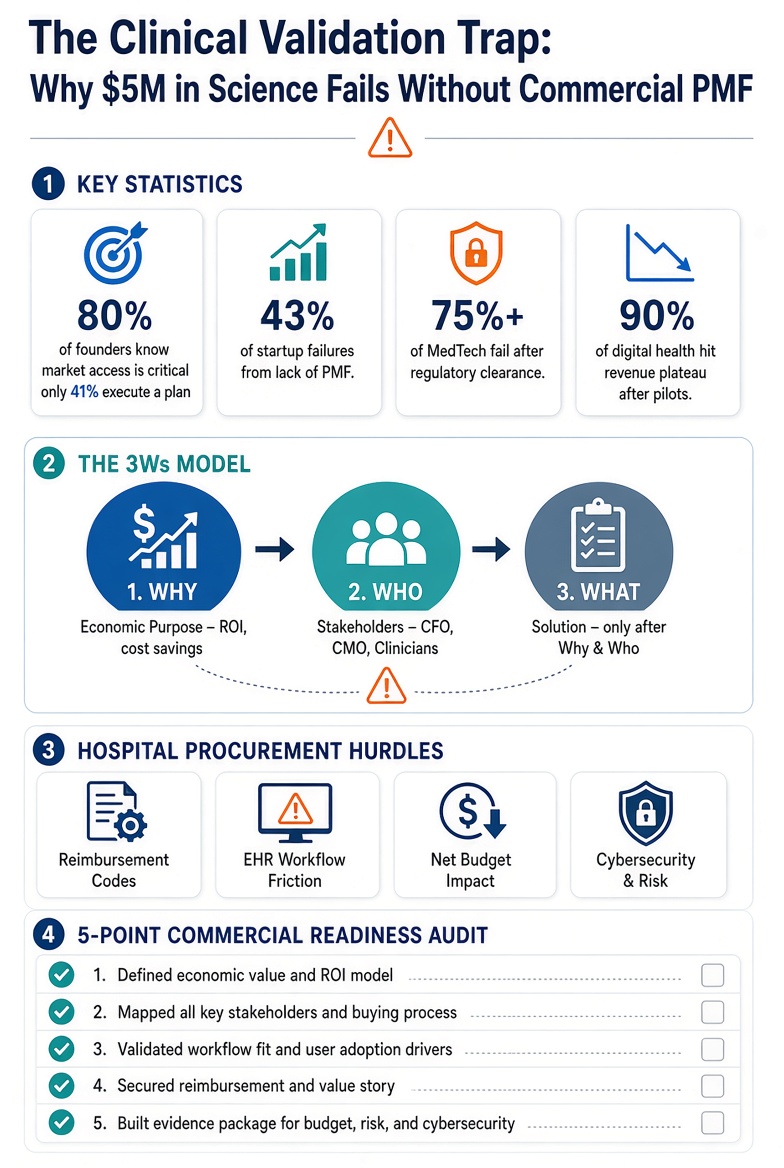
This phenomenon is comprehensively documented in empirical research. In a landmark industry study conducted by Siro Gottardi et al. (published via Viopas Venture Consulting and Plattform Life Sciences under the title ‘HealthTech Insights: Startup market access readiness’), researchers uncovered a dramatic execution disconnect: over 80% of HealthTech founders explicitly recognize that market access and commercial validation are critical to company survival from day one. However, only 41% of those same startups manage to execute a structured market access plan effectively. This 80/41 execution gap represents a systemic failure in how medical technology companies transition from scientific research to commercial scaling.
The financial consequences of this gap are devastating. Updated market failure data compiled by CB Insights confirms that 43% of startup failures across technology verticals are driven directly by misreading market demand and a fundamental lack of product-market fit (PMF). In specialized healthcare sectors, the mortality rate is even higher. Research from TTi Health Research & Economics indicates that more than 75% of Medical Technology (MedTech) startups fail to achieve commercial adoption after clearing regulatory hurdles. Furthermore, data presented by World Health Expo Insights reveals that 90% of early-stage digital health solutions hit a complete revenue plateau immediately following initial hospital pilot projects. Proving that a technology works in a controlled clinical trial is fundamentally different from proving that a health system will buy, integrate, and repeatedly pay for it.
2. Deconstructing the Technical Trap: The Pitch Deck Hell Loop
Why does this structural breakdown occur so consistently across early-stage health ventures? Scientific and technical founders naturally build inward. They spend years concentrating on the ‘What’ of their innovation: the core hardware specifications, the diagnostic sensitivity, the proprietary biomarker assay, or the artificial intelligence algorithm. Founders operate under the unexamined assumption that if the science is superior and the clinical trial results are statistically significant, the healthcare system will naturally beat a path to their door.
However, healthcare markets do not purchase abstract scientific elegance. Healthcare institutions are complex, risk-averse human ecosystems governed by strict budgetary constraints, rigid procurement policies, and ingrained clinical habits. Under the Business-to-People (B2P) strategic framework developed by The Engagement Strategy Group, commercial viability requires reversing traditional development logic through the 3Ws Model. Founders must define commercial alignment in three strict, non-sequential steps:
- Define the Commercial ‘Why’ (Economic Purpose): Before locking in software architecture, hardware features, or clinical trial endpoints, founders must articulate why an economic buyer will allocate actual budget to this solution today. What specific financial liability does the product reduce? Does it directly shorten hospital length of stay, reduce readmission penalties under value-based care contracts, or open a new reimbursable billing pathway?
- Map the Human ‘Who’ (Stakeholder Community): Who are the distinct human stakeholders who must approve, implement, and operate the tool? In healthcare, the individual who evaluates the clinical science (the attending physician) is almost never the person who controls the budget (the hospital CFO or procurement committee), and neither is the end user (the patient or clinical nurse). Commercial success depends on mapping the exact alignment between these three roles.
- Build the Product ‘What’ (The Solution Mechanism): Only after the economic ‘Why’ and the stakeholder ‘Who’ are explicitly defined should the clinical product features be finalized. Building the ‘What’ first without validating the ‘Why’ and ‘Who’ traps founders in ‘Pitch Deck Hell’, where they repeatedly tweak investor slides and clinical features while burning precious cash runway, oblivious to the fact that their underlying commercial architecture is broken.
3. The Hospital Procurement Wall: CFOs Buy ROI, Not Clinical Trials
A primary driver of early-stage HealthTech stagnation is the profound disconnect between clinical trial endpoints and hospital purchasing criteria. A chief medical officer or department head may be genuinely impressed by a technology’s clinical efficacy, but they lack the unilateral authority to sign a purchase order. In modern health systems, purchasing decisions have shifted decisively toward hospital Chief Financial Officers, revenue cycle managers, and enterprise procurement committees.
Hospital CFOs evaluate new technology through a rigorous financial lens that extends far beyond clinical efficacy. They analyze four specific commercial hurdles before approving any enterprise contract:
- Reimbursement Coding & Coverage Pathways: Does the product align with existing Current Procedural Terminology (CPT) codes, Medicare Severity Diagnosis Related Groups (MS-DRG), or regional national health insurance coverage? If a product requires a health system to lobby for a novel, unestablished reimbursement code, the sales cycle instantly expands by 24 to 36 months.
- Workflow Friction & EHR Compatibility: Does the tool integrate natively into existing Electronic Health Record (EHR) platforms such as Epic, Cerner, or Allscripts without requiring clinicians to log into a separate browser tab or manually copy patient data? Any solution that adds operational friction or additional clicks to a physician’s daily workflow faces immediate clinical rejection.
- Net Budget Impact & Payback Horizon: What is the net financial impact on the hospital’s operational margin over a 12-month period? A solution that saves $50,000 in clinical labor but costs $100,000 in software licensing and IT integration is a net loss for the institution, regardless of its clinical beauty.
- Enterprise Risk & Information Security Compliance: Does the technology meet enterprise cybersecurity standards (HIPAA, SOC2 Type II, GDPR, ISO 27001) and pass legal risk assessments? Cybersecurity compliance failure is one of the most common reasons hospital pilot projects fail to transition into paid enterprise contracts.
4. The B2P Paradigm Shift: Moving from Broadcast Theater to Authentic Market Trust
Overcoming the clinical validation trap requires a fundamental shift in how healthcare companies communicate with their market. Traditional B2B healthcare marketing relies heavily on ‘Broadcast Theater’, characterized by one-way corporate presentations, glossed marketing brochures, and aggressive sales pitches that treat hospitals as impersonal institutions. This broadcast approach fails because health systems are not faceless entities; they are networks of risk-averse human beings trying to protect patient safety while maintaining operational stability.
The Business-to-People (B2P) framework shifts the paradigm from broadcast theater to bilateral discourse. Instead of broadcasting generic claims, growth architects build transparent, trusted dialogue with medical directors, department chairs, and procurement leaders long before a commercial contract is presented. B2P growth relies on measuring High Quality Engagement (HQE), evaluating the depth of market trust, active clinical dialogue, and stakeholder alignment rather than collecting vanity metrics like impression counts or unverified email lists.
By engaging clinicians and health system leaders as active co-creators during early development, founders uncover hidden workflow obstacles and economic realities early enough to adjust product design. This collaborative trust building transforms skeptical medical gatekeepers into vocal internal advocates who champion the technology through internal hospital budget committees.
5. Diagnostic Framework: The HealthTech Commercial Readiness Audit
To determine whether your HealthTech, BioMed, or Digital Health startup is prepared to breach the commercial market, executive leadership teams and board members should conduct a rigorous diagnostic audit. Evaluate your venture against these five strategic criteria:
- Economic Buyer Identification: Have you identified the exact CPT, HCPCS, or DRG codes that allow the health system to bill for your solution, or verified an established out-of-pocket budget line?
- Workflow Friction Audit: Can your product operate within the clinician’s existing EHR interface without adding manual data entry or extra login steps?
- Quantified Financial Impact: Have you documented a quantifiable 12-month net budget savings or revenue generation model verified by an independent hospital CFO or billing expert?
- Stakeholder Messaging Alignment: Is your commercial message tailored specifically to the human priorities of the CFO (cost reduction), the CMO (clinical risk), and the CIO (data security)?
- Clinical Champion Engagement: Have you established formal design partnerships with clinical champions who are incentivized to drive internal adoption?
Bridging the execution gap between clinical validation and commercial market access is the defining challenge for modern healthcare founders. If they ground development in the 3Ws Model, respect hospital procurement realities, and execute a B2P engagement strategy, health ventures can transform breakthrough science into sustainable, market-leading commercial reality.