
Startups do not usually begin in boardroom meetings; they begin with a spark of frustration. A medical doctor notices a recurring inefficiency in the clinic; a scientist discovers a molecule that could alter the course of a disease; an accountant invents a cleaner way to audit financial ledgers. This is the classic birth of the specialist founder. These are people with immense domain authority, individuals who have spent years mastering a specific craft, science, or technical landscape.
But this exact brilliance often contains a silent, structural trap. It is a psychological phenomenon I call the specialist’s myopia.
When you are an expert in your field, you are accustomed to solving complex problems through sheer individual intellect. You assume that because you understand the science, the craft, or the service deeply, the business of bringing it to the world will naturally fall into place. You believe that a superior product is all it takes to win. This assumption is not only incorrect; it is one of the primary reasons why brilliant innovations fail to survive the market.
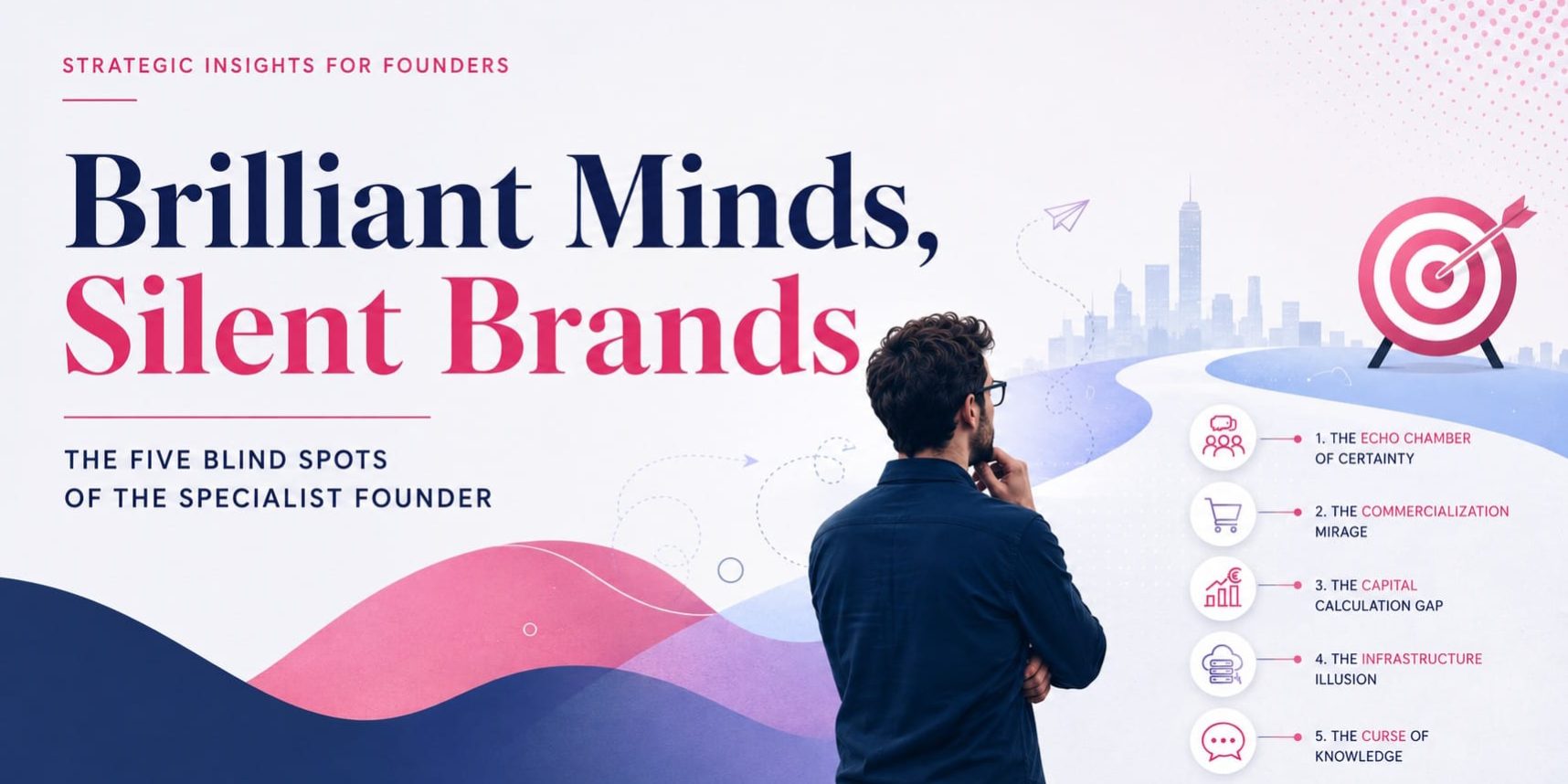
The Five Blind Spots of the Specialist Founder
Over my twenty five years in this ecosystem, I have sat across the table from hundreds of these founders. They are brilliant, passionate, and deeply committed. Yet, they almost always stumble into the same five gaps. If we want to educate rather than insult, we must look at these blind spots with absolute honesty.
1. The Echo Chamber of Certainty
The first blind spot is falling in love with your own solution before validating if anyone else actually wants it.
Consider the experienced marketer who encounters a minor daily irritation in their workflow. They spend thousands of euros developing a software platform to solve this specific inconvenience, convinced that every other marketer is desperate for the same tool. But they never stop to run proper, unbiased market research. They do not validate if the problem is a universal pain or merely a personal annoyance. They build a highly specific tool for an audience of exactly one.
When you start with the product, the “What,” rather than the human need, the “Why” and the “Who,” you create a solution looking for a problem. You spend your precious capital building a monument to your own assumptions.
2. The Commercialization Mirage
Many specialist founders operate under the belief that a great product naturally overcomes regulatory, pricing, and distribution hurdles.
A brilliant scientist might spend five years developing a revolutionary health supplement. They understand the biochemistry perfectly, but they have zero knowledge of commercialization, pricing models, or actual market access. They assume that once the product exists, distributors will fight to put it on shelves. They are unaware of the intricate, often hostile landscape of retail margins, supply chains, and positioning.
Innovation can take years to manifest, but if you do not plan with a clear commercial roadmap from the beginning, your product will die on the shelf, no matter how pure the science behind it is.
3. The Capital Calculation Gap
Raising money is a specialized skill, yet experts often believe their technical authority alone will open investor checkbooks.
They do not know how to calculate how much capital they actually need to reach their next milestone, nor do they know how to speak the language of finance. When they pitch to investors, they deliver a highly technical lecture on the features of their product rather than explaining the commercial viability of their business. They do not realize that investors do not buy technology; they buy return on investment.
If you cannot translate your clinical data or craft into a viable, scaling financial narrative, you will run out of cash before your product ever sees the light of day.
4. The Infrastructure Illusion
This is a classic form of technical naivety. A founder understands their product, but they are entirely blind to the technical infrastructure required to support it.
Take the master jeweler who decides to build a digital platform to help other independent jewelers manage their custom orders. They understand jewelry design, but they do not understand software architecture. They hire freelance developers without a clear strategy, unaware that they need proper DevOps from the very first day. They do not plan for data privacy, server optimization, or secure cloud environments.
A year later, their platform suffers constant server crashes, database collapses, and mounting cloud costs that drain their budget. Because they did not have a specialist architect planning their infrastructure to be cost effective from day one, they are forced to scrap their code and start over.
5. The Curse of Knowledge
The final, most common blind spot is the translation gap. Specialist founders are often incapable of speaking to people who are not exactly like them.
The doctor speaks in dense, clinical jargon; the engineer speaks in lines of code; the jeweler speaks in technical gemology terms. They do not know how to build a relatable brand story or a narrative that connects with the human soul of their audience. They are afraid that if they simplify their message, they will dilute their scientific integrity. They fail to understand that to connect with a wider audience, you must translate complex data into visual stories and human experiences.
If your brand remains narratively silent, you are standing on a stage shouting features at an audience that has already tuned you out.
The Solo Hunter Paradox and the Stag Hunt
Why do these blind spots persist? It usually comes down to the expert’s hubris. When you are used to being the smartest person in the room, it is incredibly difficult to admit what you do not know. You want to maintain complete control. You try to play every role yourself: the visionary, the developer, the marketer, the financial officer, and the CEO.
This brings us to the solo hunter paradox, a strategic dilemma that we can understand deeply through game theory.
In his classic work on social cooperation, the philosopher Jean-Jacques Rousseau described a scenario known as the Stag Hunt. Imagine two hunters in a wild forest. They must decide, independently and without knowing what the other will do, how to hunt.
They have two choices:
- The Hare: A small, low value target. A single hunter can easily catch a hare on their own with zero coordination and zero trust. The payoff is immediate, but it is small. It is barely enough to survive.
- The Stag: A massive, high value prize that can feed the entire village for weeks. However, hunting the stag is a coordinated game. It is physically impossible for one person to catch a stag alone. It requires both hunters to work in perfect cooperation, trusting each other’s specialized skills.
If one hunter decides to chase the stag while the other secretly defects to catch an easy hare, the stag hunter gets absolutely nothing. They run themselves ragged and starve in the forest.
In the startup ecosystem, trying to build a sustainable, secure, and scaling enterprise is the Stag. It is a massive, highly rewarding goal. Chasing the “hare” is the desire for complete, individual control.
When a specialist founder refuses to collaborate, when they insist on hunting alone because they believe they can master marketing, finance, technology infrastructure, and operations on their own, they are chasing the hare. They might catch a small prototype or a minor grant, but the business cannot scale.
Game theory dictates that if you try to hunt the stag alone, your payoff is mathematically zero. You will run out of cash, suffer critical security breaches, or build a product that nobody actually needs.
Embodying Cooperative Specialization
The hard, unfiltered truth is this: you can come up with the brilliant idea and be the passionate engine of your company, but that does not make you a CEO or a CMO.
True leadership is not about knowing how to do everything; it is about having integrity and the self-awareness to know where your expertise ends. Your genius is your science, your design, or your craft. Do not dilute that genius by trying to play roles you were never trained for.
To catch the Stag, you must embrace cooperative specialization from day one. You do not need to become a marketing guru or a cloud architect. You need to focus on your vision and bring in advisors, mentors, or fractional specialists who hold the expertise you lack. This is how you bridge the gap between dry data and human trust, ensuring that your technical brilliance is matched by a secure technical foundation and a narrative that truly speaks to people.
If you are ready to quit the tactical rat race and audit your strategic alignment, let’s begin a conversation.
You can book a free (no strings attached!) call with me here.