

TL;DR
The ninety-day post-raise trap is a critical period of narrative silence where specialized startups lose their temporary organic press momentum after a funding round. To avoid this trap, technical and scientific founders must secure their launch window by building a primary owned trust channel. This strategic architecture preserves credibility with investors and regulators before the initial wave of media attention evaporates.
The moment the wire transfer clears and your funding announcement hits the press, your world changes.
If you are a technical, scientific, or medical founder, you feel a mixture of relief and intense anticipation. You have spent months pitching, negotiating, and waiting. Now, you finally have the capital to execute your vision.
The media coverage goes live. Your inbox fills with congratulations from peers, candidates, and partners. Your website traffic spikes. For a brief period, you have the undivided attention of your entire market.
This is your post-raise launch window. It is the most valuable, highly concentrated wave of organic attention your startup will ever receive.
It is also incredibly quiet.
What many founders do not realize is that this immediate post-funding wave of press and market attention is highly temporary. Within a few weeks, the congratulations fade. The media moves on to the next announcement. If you have not built an owned, structured container to capture and hold that attention, it simply evaporates.
Your brand falls into narrative silence.
To make matters worse, your new board members are already looking for immediate signs of market momentum. Rushing into traditional marketing campaigns or hiring a full-scale agency during this chaotic transition is a common mistake. It drains your newly acquired capital and distracts your leadership team when you need to focus on product development and hiring.
For specialized founders in highly regulated sectors like fintech, biotech, and healthtech, this transition is particularly treacherous. Right after a major raise, four severe, invisible cracks tend to open up in their strategic communication.
A Note on Industry Boundaries
While this post is illustrated through the high-stakes lens of scientific, clinical, and technical ventures, the narrative cracks below can open under any founder’s feet. Whether you are scaling an enterprise software platform, a consumer service, or a specialized marketplace, the sudden transition from raising capital to proving market momentum is a universal challenge. The pressure to translate complex progress into human trust does not care about your industry sector.
What are the four communication cracks for post-raise founders?
1. How do technical founders bridge the translation gap?
As a technical or scientific founder, you are brilliant at explaining your code, your clinical pipeline, or your regulatory requirements. You speak in complex data and engineering metrics.
However, your broader stakeholders speak in human terms.
When you try to communicate with the wider market, a severe translation gap occurs. Your in-house team often lacks the specialized depth to bridge this gap. If you cannot translate your complex science into a clear commercial narrative, you risk confusing your market. In a specialized sector, getting your message wrong with an investor or regulator is not just a missed sale; it is an existential risk.
2. How can startups manage multi-stakeholder narrative complexity?
For example, A newly funded fintech or healthtech startup does not have a single, simple target audience. Instead, you must communicate simultaneously with a highly complex web of stakeholders:
- Regulators who demand absolute compliance and safety.
- Institutional investors who need to see clear commercial viability and governance.
- Clinicians or technical buyers who require deep scientific validation.
- Payors and insurers who focus on cost-efficiency and clinical outcomes.
- Patients, users, and families who seek personal trust, security, and empathy.
Each of these audiences speaks a different language, has different trust requirements, and needs to hear a different part of your story. Building one coherent, overriding narrative that serves all of these layers without collapsing into dense jargon is a monumental task that beyond the scope of a standard in-house marketer.
The stakes are high. Recent data reveals that 75% of institutional biotech investors thoroughly review a company’s website and published digital content before they ever agree to schedule their very first management presentation. If your digital footprint is confusing or silent, you lose credibility before you even enter the room.
3. What are the regulatory communication constraints in specialized sectors?
In fintech and healthtech, what you can say, how you can say it, and where you can publish it is legally bound. Standard marketing firms simply do not understand these complex legal boundaries. Rushing to post unvetted or overly promotional claims can attract immediate regulatory scrutiny, halting your momentum before you even launch. You need a communication framework that is legally secure yet commercially powerful.
4. How does the founder identity gap impact startup scaling?
A clinician, doctor, or engineer who raised five million euros is suddenly expected to behave like a CEO, a public brand voice, and a community leader overnight. You have none of that specific training, and you have no clear strategic map for it.
This founder identity gap has direct commercial consequences. Research shows that 86% of biotech investors believe that fewer than half of startup management teams communicate effectively, which directly hurts their ability to secure subsequent funding rounds and partnerships.
Beyond the Healthtech Landscape
It is important to look at healthtech and biotech as clear, extreme examples of this complexity, but they are certainly not the only ones. These exact same communication barriers exist for a fintech founder explaining complex regulatory compliance, a deep tech founder explaining advanced artificial intelligence infrastructure, or any specialized business leader who needs to turn temporary press attention into a permanent digital asset. The specific terminology changes, but the core need for clear, bilateral trust remains identical.
Why is trust architecture a commercial necessity for startups?
The cost of letting these cracks go unaddressed is higher than ever.
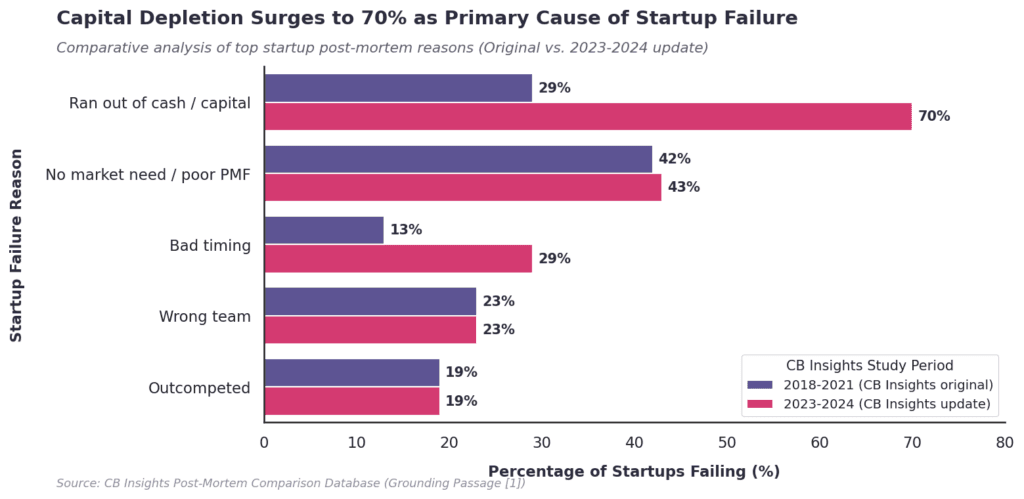
Our latest review of startup post-mortems shows that the market has become incredibly unforgiving. 70% of modern startup failures are driven by running out of cash and capital, representing a massive 41 percentage point increase from previous years. In parallel, 43% of startups fail because of a poor fit between their product and the actual market.
In this capital-constrained environment, you cannot afford to waste your funding on standard, low-yield broadcast advertising. You cannot afford bad timing, which accounts for 29% of startup mortality.
You must secure your launch window.
Securing the window does not mean building a massive, complex community infrastructure on day one. It means standing up exactly one highly optimized, owned trust channel within your first weeks of funding, such as a strategic LinkedIn newsletter, a structured investor-update cadence, or a dedicated technical community.
By focusing your resources on a single channel, you protect your team’s bandwidth while building a permanent digital asset that captures every ounce of your post-raise press momentum.
To help technical startups navigate this transition, we run The Post-Raise Trust Sprint. This is a highly focused, ninety-day program where we personally build and launch your owned trust channel, instrument your audience engagement, and deliver a complete twelve-month playbook for your team to run independently.
Do not let your post-raise momentum fade into narrative silence.
Explore the Post-Raise Trust Sprint and secure your launch window today.