

what is the “Volunteer Tax” in Healthtech?
HealthTech startups frequently alienate medical experts by demanding unpaid user research, clinical advice, and pilot feedback, a friction known as the volunteer tax. Overcoming clinician resistance requires applying the Business to People (B2P) framework: formalizing compensated Clinical Advisory Boards, structuring win-win design partnerships, and implementing Human-in-the-Loop AI architectures that reduce administrative burden rather than adding operational risk.
1. The Hidden Barrier in HealthTech GTM: Clinician Burnout and the Volunteer Tax
One of the most persistent and self-defeating operational habits of early-stage HealthTech, BioMed, and Digital Health founders is the expectation that medical experts will gladly donate their limited time to refine an unproven product. Across specialized founder communities, including Israeli BioMed, FemTech, and Mental HealthTech leadership groups, a vocal backlash has emerged against what clinicians describe as the volunteer tax.
Physicians, clinical psychologists, chief medical officers, and nursing directors are inundated daily with cold messages from venture-backed and bootstrapped startups requesting 30 minutes of free advice, unpaid protocol reviews, or free pilot evaluations. While founders view these requests as harmless user research, medical professionals experience them as an extension of institutional exploitation.
To understand why clinician pushback is intensifying, founders must examine the operational reality of modern healthcare delivery. Medical professionals are currently navigating unprecedented levels of administrative fatigue, Electronic Health Record (EHR) burnout, and cognitive overload. When a commercial startup asks a specialized physician for unpaid consulting, the founder sends an implicit message: we view your hard-earned clinical expertise and professional license as a free community resource for our commercial gain.
This transactional dynamic burns key industry relationships long before a product ever reaches market readiness. When clinicians feel exploited during early user research, they transform from potential clinical champions into cynical gatekeepers who actively block product trial within their hospitals and professional networks.
2. From Exploitation to Alignment: Structuring Sustainable B2P Clinical Partnerships
Overcoming clinician resistance requires moving away from one-sided requests and embracing the Business to People (B2P) framework developed by The Engagement Strategy Group. B2P recognizes that healthcare stakeholders are not passive data sources or transactional targets; they are specialized humans whose time, risk exposure, and professional standing must be explicitly respected and compensated.
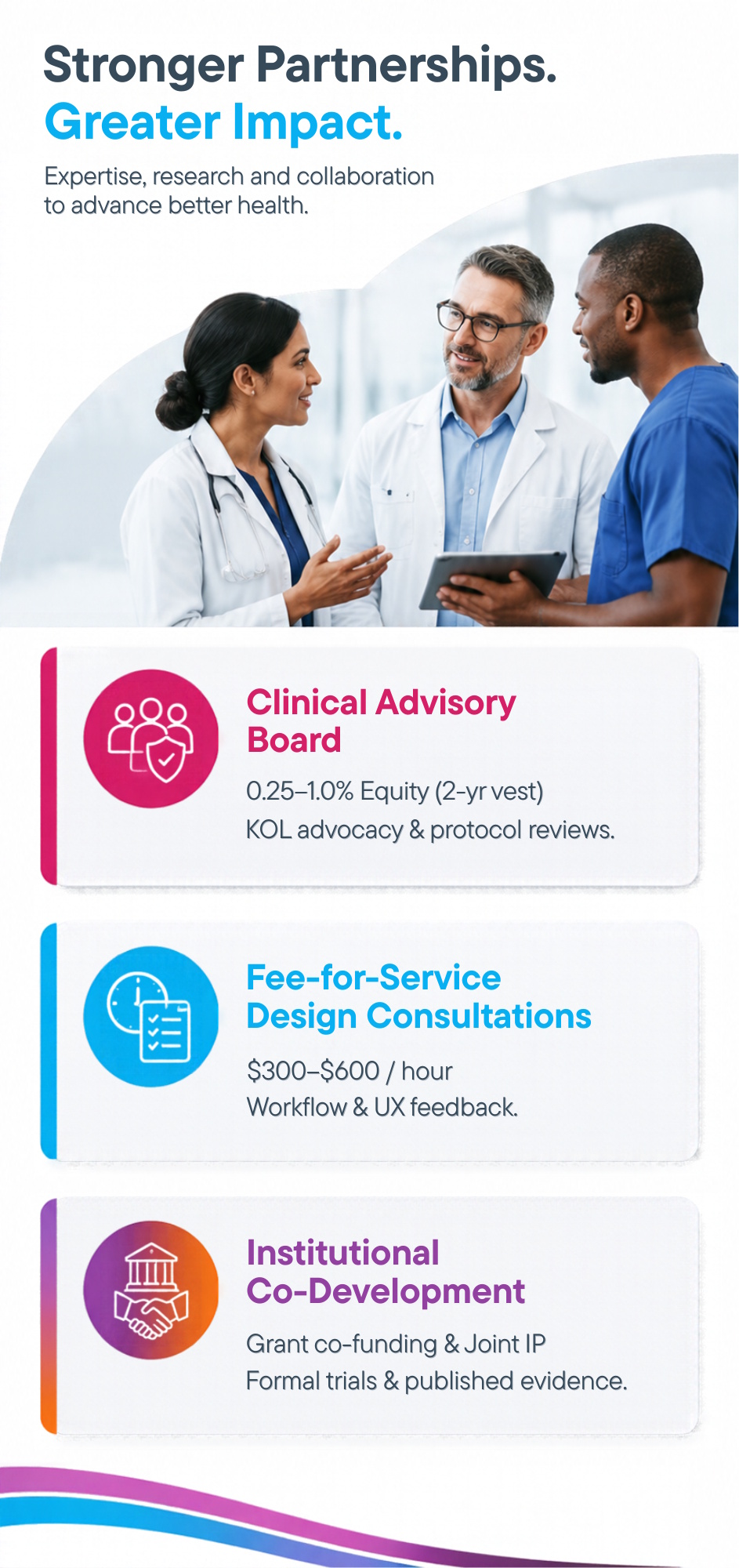
Rather than relying on informal favors, mature HealthTech ventures establish formal, mutually beneficial engagement models early in their development cycle. There are three structured frameworks for engaging medical experts ethically and effectively:
- Equity-Compensated Clinical Advisory Boards: For long-term strategic guidance, founders should establish a formal Clinical Advisory Board (CAB) with binding equity or cash retainer agreements. Typical compensation structures range from 0.25% to 1.0% equity vesting over two years, tied to explicit quarterly deliverables such as study design review, regulatory strategy input, and Key Opinion Leader (KOL) advocacy. Formalizing advisory roles elevates the relationship from informal consulting to shared commercial ownership.
- Fee-for-Service Design Consultations: When startups require tactical workflow feedback or prototype testing, they should budget for fee-for-service consulting at fair market value. Medical specialists command professional consulting rates ranging from $300 to $600 per hour depending on specialty and geography. Paying for targeted feedback sessions demonstrates professional respect and ensures honest, rigorous clinical critique.
- Institutional Co-Development Partnerships: For deep clinical validation, ventures should partner with academic medical centers or health systems through formal co-development agreements. These partnerships define clear intellectual property boundaries, grant-funding allocations, and publication rights, ensuring that clinical investigators receive academic and commercial credit for their contributions.
3. The Ethics of Health AI: Navigating the Line Between Wellness Hype and Clinical Safety
The friction between clinicians and HealthTech startups is particularly acute in digital health and artificial intelligence. A recent debate within Israeli Mental HealthTech networks highlighted growing concern over the proliferation of unregulated AI chatbots, automated coaches, and unvalidated Large Language Model (LLM) advisory platforms.
Prominent legal challenges, including high-profile lawsuits involving consumer chatbot platforms and user dependency, have triggered intense scrutiny from regulatory bodies, health systems, and clinical professionals. The market is witnessing a decisive split between consumer wellness tools and clinically validated Digital Therapeutics (DTx).
Consumer wellness apps operate with minimal regulatory oversight, relying on catchy marketing, B2C subscription models, and unmonitored conversational AI. However, these tools suffer from extreme user churn, zero institutional reimbursement, and severe liability risks when conversational agents provide hallucinated or unsafe medical advice.
Conversely, institutional health systems, hospital CFOs, and psychiatric directors reject autonomous conversational AI in favor of Human-in-the-Loop (HITL) architectures. Clinically sound AI tools do not attempt to replace human clinicians or deliver unsupervised care. Instead, they automate administrative burden, synthesize disparate patient data, and streamline billing documentation, ensuring that licensed medical professionals retain complete diagnostic authority.
Applying the R.I.S.K. AI Framework (Research, Inspiration, Structure, Know-how) developed by The Engagement Strategy Group ensures that artificial intelligence acts as a workforce multiplier rather than a clinical liability. By positioning AI as an administrative assistant that returns time to the physician, startups align their technology with clinician interests.
4. Applying the 3Ws Model to Clinical Community Architecture
To build long-term commercial momentum, HealthTech leadership teams must apply the 3Ws Model (Why, Who, What) directly to their clinician engagement strategy. Reversing development logic ensures that products are designed around clinical workflows from day one.
- Define the Why (The Clinician Economic & Operational Value)
Before presenting a clinical tool to physicians, founders must articulate why the clinician personally benefits from adopting it. Does the software reduce daily EHR documentation time by 45 minutes? Does it eliminate billing code rejections? Does it lower malpractice exposure? If a product adds administrative steps without delivering personal operational relief, clinicians will reject it.
- Identify the Who (The Human Clinical & Risk Community Map)
Healthcare purchasing decisions involve complex human ecosystems. Founders must map the distinct clinical personas involved: the attending physician who uses the tool, the nursing staff who manage data entry, the chief medical officer who evaluates clinical safety, and the department head who manages budget impact. Each persona possesses distinct anxieties and professional incentives that must be addressed individually.
- Articulate the What (The Minimal-Friction Interface)
Only after the operational Why and human Who are established should product features be finalized. The ideal clinical interface integrates seamlessly into existing hospital workflows (such as Epic or Cerner EHR systems) rather than forcing clinicians to log into a standalone web portal. Reducing workflow friction is the single most effective way to drive long-term clinical adoption.
5. The Clinician Engagement & Ethics Audit
Prior to initiating clinical outreach or launching pilot studies, HealthTech executive teams should evaluate their commercial readiness against this 5-point strategic checklist:
- Compensation Protocol Audit: Are all medical experts, clinical advisors, and research consultants formally compensated through equity or cash retainers at fair market value?
- Workflow Burden Assessment: Does the software demonstrably reduce daily administrative burden for practicing physicians, or does it require additional manual data entry?
- Clinical Liability Shield: Is diagnostic and therapeutic responsibility explicitly retained by licensed human clinicians through a Human-in-the-Loop architecture?
- Institutional Alignment Check: Are early clinical pilot studies structured with formal co-development agreements, clear IP boundaries, and published trial objectives?
- High Quality Engagement Index: Is the company tracking qualitative clinician trust and advocacy using the High Quality Engagement (HQE) Index rather than relying on raw user sign-ups?
Respecting the Human Soul of Healthcare
When a HealthTech venture respects clinician time, compensates specialized expertise, and embeds human-in-the-loop safety into its technology, the commercial dynamic transforms completely. Physicians evolve from skeptical, overworked gatekeepers into active co-creators, clinical champions, and vocal advocates. Protecting the human relationships behind medical practice is not merely an ethical obligation; it is the ultimate competitive advantage in modern digital health.