

Why does startup growth stall?
Startup growth stalls when executive teams confuse acute tactical symptoms with underlying strategic pathology. When post-raise commercial momentum flattens, hiring external UI/UX, ad, or SDR agencies provides temporary symptomatic relief while leaving strategic debt unaddressed. Curing a growth stall requires a comprehensive diagnostic triage to realign buyer ROI, clinical user realities, and commercial trust before capital runs out.
1. The Diagnostic Error: Why Startup Growth Stalls After Funding
Every founder remembers the high-energy rush of closing a funding round. The pitch deck landed, the investment capital hit the bank account, and the mandate from the board was crystal clear: accelerate commercial growth.
Yet, within six to twelve months post-raise, an alarming pattern takes hold across HealthTech, MedTech, and specialized B2B ventures. The initial surge of customer interest slows to a crawl. Demos taper off. Pipeline velocity drops. The executive team convenes in emergency sessions, staring at a sobering reality: despite an expanded headcount and fresh capital, commercial expansion has hit a brick wall.
Why does startup growth stall right when resources are at their peak?
In most boardrooms, the immediate reaction is a diagnostic misfire. Leadership examines the outward symptoms of the business and concludes that the company suffers from an execution deficit. They see a low-converting website, an empty lead pipeline, or ineffective outbound emails.
Believing these surface manifestations to be the core illness, founders rush to prescribe acute tactical remedies. They retain digital marketing agencies, commission site overhauls, or sign contracts with outbound sales automation vendors.
This is the central diagnostic error of scaling companies.
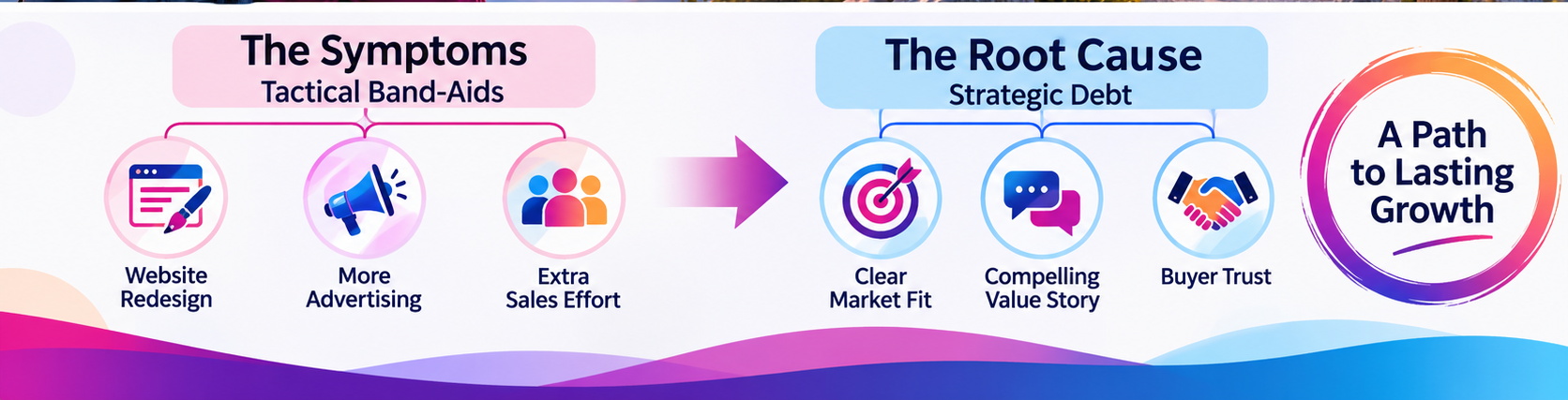
When you treat surface symptoms with tactical band-aids, you perform the business equivalent of administering high-dose pain relievers to a patient suffering from an internal hemorrhage. The pain relievers may temporarily mask the distress, but they do nothing to address the underlying disease. Until you perform a rigorous strategic triage and cure the root cause, your commercial growth will remain stagnant while your cash runway bleeds out.
2. Prescribing High-Dose Painkillers: The 3 High-Cost Agency Band-Aids
When commercial traction flatlines, executive teams typically rotate through three classic agency interventions. Each intervention promises a quick cure. Each intervention treats an acute symptom. And each intervention fails because it leaves the root cause untouched.
The Website Redesign Fallacy: Masking Narrative Silence with Aesthetic Treatments
When inbound sales leads dry up, the most common knee-jerk reaction is to blame the website. The executive team looks at the current landing page, decides it feels dated or overly technical, and hires a UI/UX agency for thirty thousand dollars to execute a complete visual overhaul.
The agency delivers sleek modern typography, fluid animations, and high-resolution visual assets. The new site looks stunning.
Yet, three months after launch, conversion rates remain stubbornly flat.
Why did the treatment fail?
Because the site redesign treated a cosmetic symptom while ignoring the underlying pathology: Narrative Silence. The old website was not failing because the layout was outdated; it was failing because it spoke entirely about internal product specifications rather than solving the buyer’s operational risk. Re-skinning a site that lacks a clear value thesis simply packages your strategic confusion in a prettier design wrapper.
The Performance Marketing Trap: Broadcasting Misalignment at Scale
The second common prescription for a growth stall is paid performance marketing. When organic acquisition slows, founders hire a media buying agency to manage thousands of dollars in monthly LinkedIn or Google ad spend.
The logic seems sound: if buyers are not finding the product, we must force the offer in front of their eyes.
However, running paid advertising campaigns for a platform with an unaligned market narrative does not generate qualified pipeline. It simply broadcasts your positioning failure at scale.
In regulated health and specialized technology sectors, economic decision-makers do not buy complex platforms because of a catchy ad headline or a sponsored banner. When you run paid ads on top of broken commercial messaging, you convert expensive capital into vanity impressions while driving up your customer acquisition costs.
The Automated Outreach Delusion: Flooding the Market with Digital Noise
The third agency band-aid is the brute-force outbound campaign. Founders hire lead generation agencies that promise fifty booked meetings a month through automated email sequences and multi-channel SDR outreach.
The agency sets up secondary domains, warms up email accounts, and blasts thousands of templated messages to targeted executive lists.
Predictably, response rates hover near zero point two percent, and the few meetings that do get booked turn out to be low-fit exploratory calls that never translate into closed revenue.
High-volume automated outreach fails because it confuses market exposure with market trust. When prospective buyers receive generic, un-targeted cold emails, they recognize the broadcast theater instantly. The campaign does not build pipeline; it burns through your total addressable market and degrades your executive reputation.
3. Uncovering the Root Cause: Strategic Debt and Misaligned Buyer Value
If website overhauls, ad campaigns, and outbound sweeps cannot fix a commercial slowdown, what is the true root cause?
Why startup growth stalls always traces back to a structural ailment known as Strategic Debt.
Strategic debt accumulates when a company advances its technical validation without simultaneously building its commercial trust architecture. In specialized B2B and healthcare innovation sectors, founders often spend years perfecting core technology, earning regulatory approvals, or publishing clinical evidence.
However, when it comes time to scale, they discover a profound translation gap between two distinct audiences:
- The Clinical or Technical User: The specialist who uses the tool day-to-day and cares deeply about feature capabilities, workflow efficiency, and technical precision.
- The Economic Buyer: The CFO, VP of Procurement, or Health System Executive who holds the budget and cares exclusively about financial ROI, operational risk reduction, regulatory compliance, and organizational liability.
When startup growth stalls, it is almost always because leadership is pitching clinical features to economic buyers, or broadcasting high-level marketing buzzwords to technical evaluators.
The company has built a sophisticated product, but it has failed to define three foundational truths:
- The Operational Why: Why must the institution allocate budget to solve this problem right now, rather than maintaining their current status quo?
- The Economic Who: Who specifically bears the financial risk of inaction, and what metrics determine their professional success?
- The Value What: What clear, defensible business outcome does the solution deliver that justifies the friction of organizational change?
When these three elements are unaligned, no amount of tactical marketing can create sustainable momentum. The company suffers from an internal structural blockage that blocks commercial health.
4. The Diagnostic Triage: How to Cure a Growth Stall Before Capital Exhaustion
Curing a commercial growth stall requires stepping back from tactical execution and conducting an unvarnished strategic triage.
Instead of asking how to generate more leads this week, executive leadership must examine the core structural architecture of their commercial system. This triage focuses on four critical diagnostic checkpoints:
Step 1: Isolate the Translation Gap Between Users and Buyers
Begin by auditing every customer touchpoint to verify whether your messaging speaks to the economic buyer or merely to the end-user.
In healthcare and complex B2B sales, end-users love technical features, but economic buyers authorize purchase orders. If your website, pitch decks, and sales collateral focus ninety percent of their real estate on technical specifications and zero percent on economic risk reduction, you have identified your primary barrier to growth.
Step 2: Audit Your Narrative Trust Foundation
Evaluate whether your brand is actively building commercial trust or operating in narrative silence.
Authentic market trust is built through direct, peer-to-peer discourse that educates the market on industry risk, operational realities, and systemic change. If your public presence consists solely of self-focused press releases, award announcements, and generic promotional posts, your market sees a vendor pushing a product rather than a strategic partner solving an industry challenge.
Step 3: Align Internal Execution Around Commercial Product-Market Fit
Ensure your product development, marketing messaging, and sales outreach are aligned around identical definitions of value.
In many stalled ventures, product teams build for future technical edge-cases while sales teams scramble to sell current features, and marketing campaigns promote abstract vision statements. This internal fragmentation creates friction at every stage of the funnel. Aligning these three functions around a single commercial narrative eliminates wasted energy and sharpens execution.
Step 4: Replace Tactical Retainers with Growth Architecture
Stop funding short-term agency retainers that promise superficial fixes.
Instead, invest in building a permanent strategic growth architecture. This means establishing owned trust channels, defining clear buyer personas based on economic risk, and structuring your go-to-market execution around sustainable relationship-building rather than transactional spam.
5. From Symptomatic Relief to Systemic Health: Restoring Commercial Traction
Recognizing that your company’s growth stall is a strategic pathology rather than an execution failure is the first step toward recovery.
Tactical remedies are tempting because they offer the illusion of rapid action. Signing an agency contract or launching a new ad campaign feels productive. But when post-raise momentum flattens, piling tactical execution on top of strategic debt only accelerates capital burn while delaying necessary commercial realignments.
Only when diagnosing the true root cause of your growth stall, can you regain control over your commercial trajectory.
When you replace surface-level band-aids with a clear, aligned commercial architecture, your marketing messaging resonates with economic decision-makers, your sales cycles compress, and your commercial growth becomes predictable, scalable, and resilient.
Do not let acute tactical symptoms blind you to underlying strategic needs. Take a breath, conduct a thorough diagnostic triage, and build the structural foundation required for long-term commercial health.